
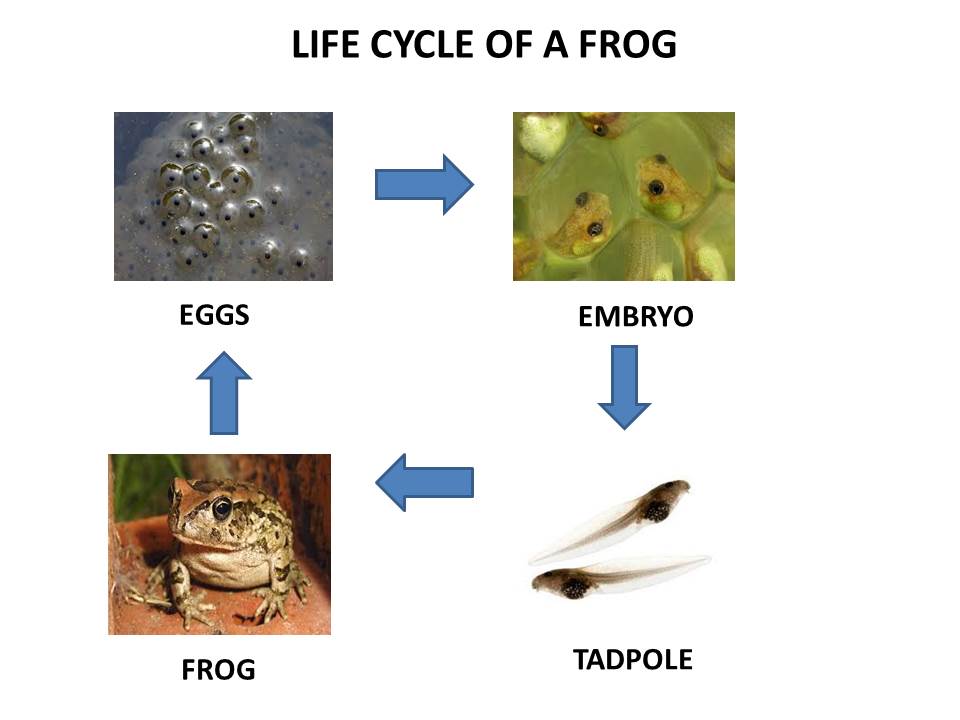
The first stage is the egg stage. Eggs are usually laid in or near water. A frog can lay thousands of eggs at once. The eggs are laid in large groups. There are covered in jelly which makes them slippery. The jelly protects them from other animals eating the eggs.
The mass of cells in the egg come to form an embryo. Organs and gills begin to form, and in the meantime, the embryo lives off of its internal yolk. This supplies it with nutrients for 21 days.
After its 21 day development period, the embryo leaves its jelly shell, and attaches itself to a weed in the water. This quickly becomes a tadpole, a baby frog. The tadpoles grow until they are big enough to break free into the water. This can take from 3 days to 3 weeks, depending on what kind of frog they will become. They eat very small plants that stick to larger plants in the water. These tiny plants are called algae. The tadpole has a long tail, and lives in the water. It is extremely vulnerable, and must rely on its camouflage to protect it.
The tadpole has a long tail, and lives in the water. It is extremely vulnerable, and must rely on its camouflage to protect it. The tadpoles also face danger by being eaten by other water animals. Sometimes the pond dries up. As a result the tadpoles die.
Eleven weeks after the egg was laid, a fully developed frog with lungs, legs, and no tail emerges from the water. This frog will live mostly on land, with occasional swims. The tiny frogs begin to eat insects and worms. Eventually, it will find a mate. The way this is done varies depending on the species. The female lays the eggs, the male fertilizes them, and the whole process begins again.
 sqattraction.video.blog