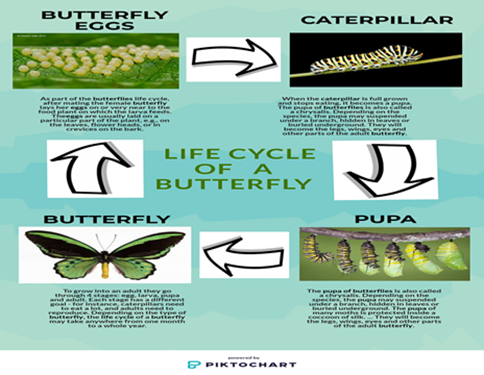
The Life-Cycle of a Butterfly and moths undergo complete metamorphosis in which they go through four different life stages.
Egg – A butterfly starts its life as an egg.
Larva – The larva (caterpillar) hatches from an egg and eats leaves or flowers almost constantly. The caterpillar molts (loses its old skin) many times as it grows.
Pupa – It turns into a pupa (chrysalis); this is a resting stage.
Adult – A beautiful, flying adult emerges. There is no growth during this stage. This adult will continue the cycle and reproduce.
As part of the butterflies’ life cycle, after mating the female butterfly lays her eggs on or very near to the food plant on which the larva feeds. The eggs are usually laid on a particular part of the plant, e.g., on the leaves, flower heads, or in crevices on the bark. Caterpillars are insects which mean they have three body parts (head, thorax, and abdomen) and two antennae on their heads. Most caterpillars are herbivores, which mean they eat plants. Caterpillars eat constantly so that they can grow. The metamorphosis from a caterpillar into a butterfly occurs during the pupastage. During this stage, the caterpillar’s old body dies and a new body forms inside a protective shell known as a chrysalis. Butterflies are beautiful, flying insects with large scaly wings. Like all insects, they have six jointed legs, 3 body parts, a pair of antennae, compound eyes, and an exoskeleton. The three body parts are the head, thorax (the chest), and abdomen (the tail end). The butterfly’sbody is covered by tiny sensory hairs.
 sqattraction.video.blog